Projekt Guide · Landscape Lighting Design
How to Uplight Trees
Lighting that grows with you.
A field guide to placement, beam spread, fixture selection, power, controls, growth, and maintenance.
Written by the Projekt Supply Lighting Team.
Field guidance based on practical lighting application experience. Electrical installation must follow product instructions, applicable codes, and qualified professional requirements.
Last reviewed September 15, 2026. First published September 3, 2026.
A palm is a vertical column plus crown. A branching tree is trunk, limbs, and canopy mass. Balanced lighting does not make one tree overwhelm the yard.
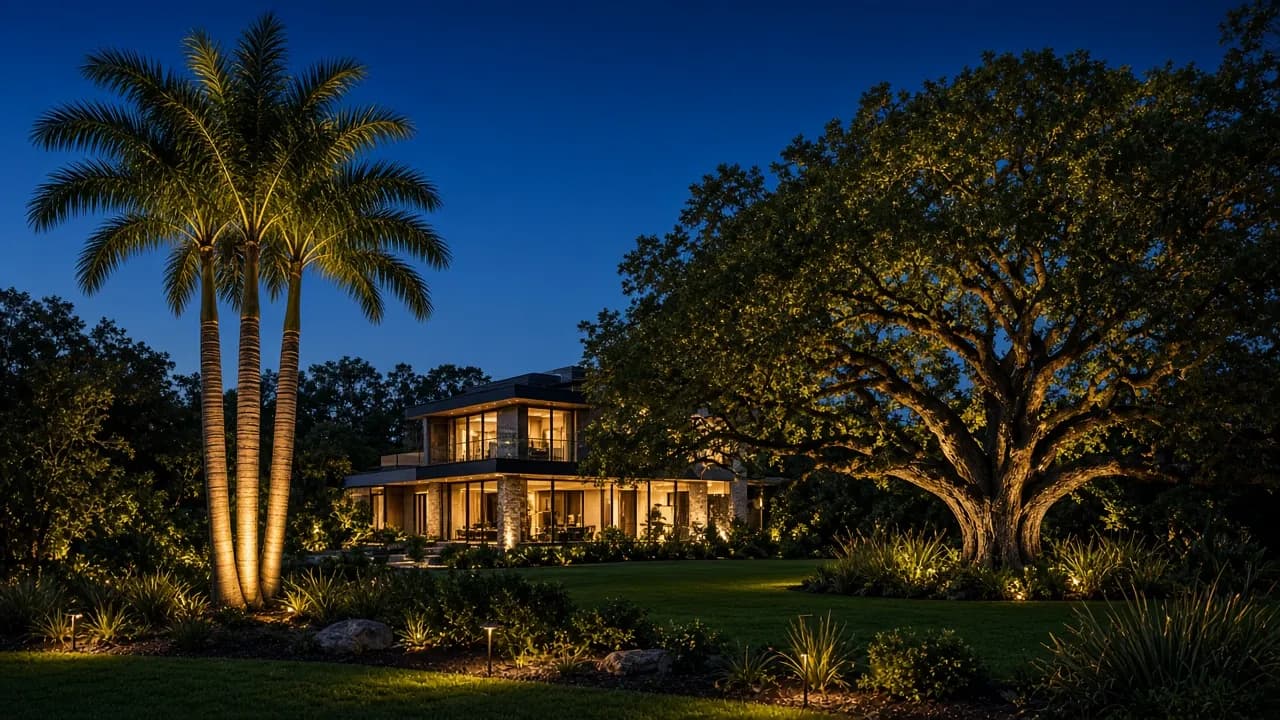
Palm
Narrower vertical beam
Branching tree
Layer trunk + canopy
Balanced scene
No single tree overwhelms the yard.
Tree uplighting looks simple when you see the finished result. Put a light under a tree, point it up, and you're done. Except that is usually where the problems start.
A tree has height, width, structure, foliage, ground conditions, viewing angles, traffic around it, and one other thing that is easy to forget: it grows. Good tree lighting starts before you choose a fixture. Start by reading the tree and the space around it.
Start by reading the tree
Before thinking about wattage, beam angle, or model number, look at four things: height, width, tree form, and ground clearance. Ground clearance matters because the best theoretical fixture location may not actually be usable.
A tree may sit in open lawn, inside a raised planter, or among dense shrubs, gravel, roots, irrigation, or foot traffic. Then ask one more question: Where will people actually see the tree from?
Do not begin by asking how many watts you need. Begin with: where can I put the light, and what kind of fixture can work there?
Tree lighting decisions start with the tree, the ground, and the view.
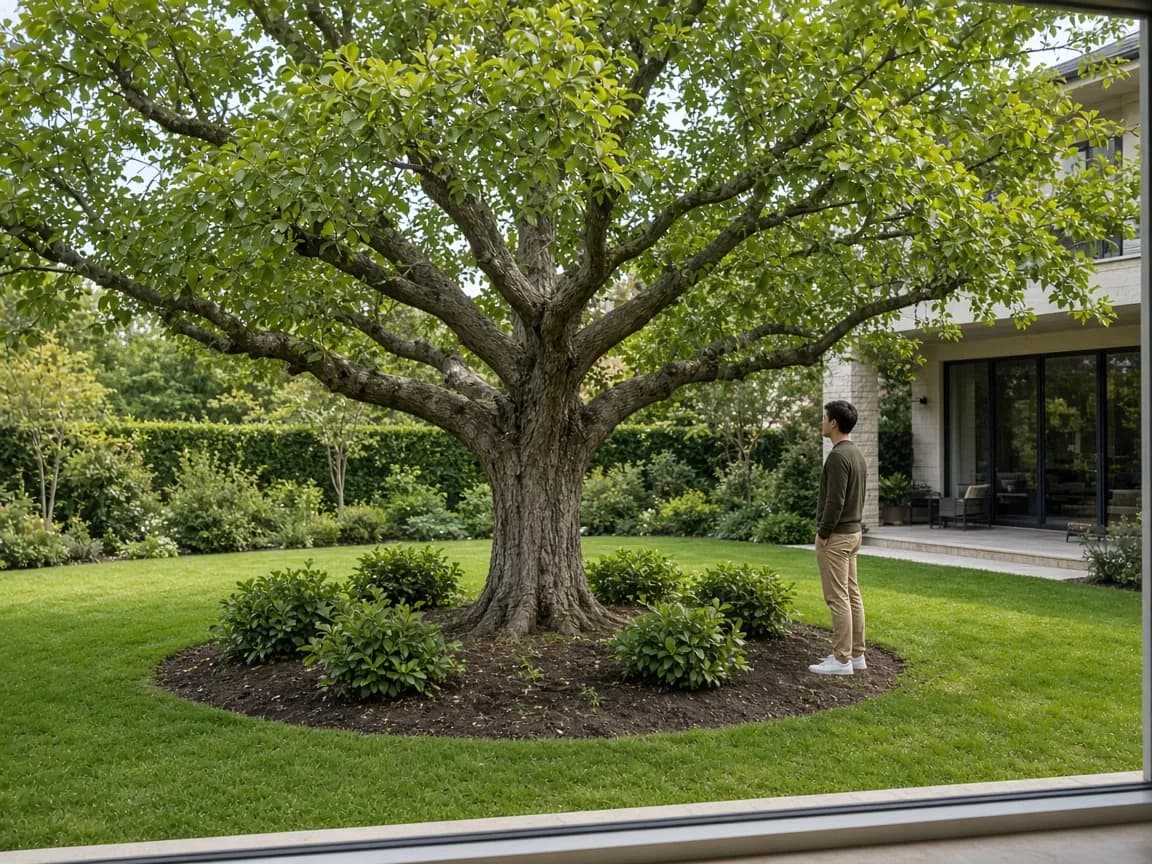
Height
How tall is it now?
Width
How far does the canopy spread?
Clearance
Can a fixture actually live here?
View
Where will people see it from?
Design for the tree it will become
The newly planted tree is six feet tall. One small uplight looks great. Two years later the tree may be fourteen feet tall, wider, denser, and blocking the same beam that looked perfect on day one.
That does not mean you should overlight a young tree today. It means the original layout should leave a path for tomorrow: a second fixture later, transformer headroom, re-aiming, wire that can extend, and a mounting location that stays accessible.
Lighting that grows with you starts with a layout that can add a fixture, re-aim, and keep the mounting location accessible.
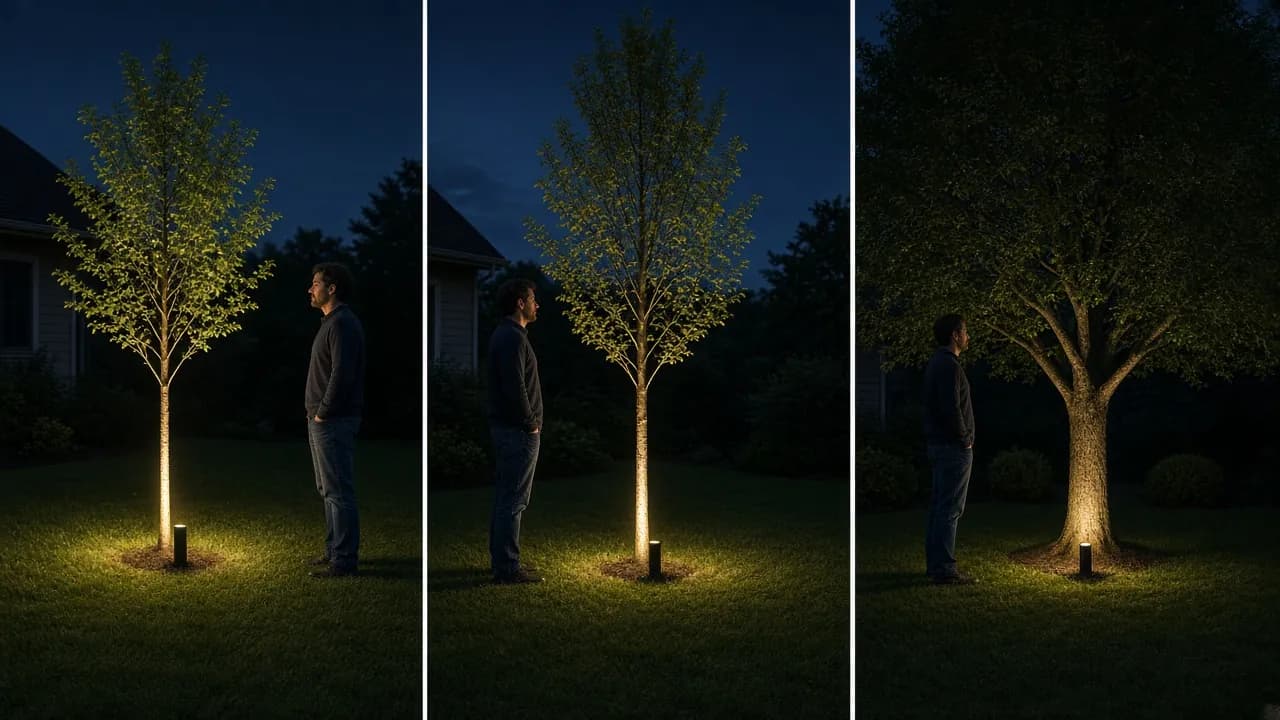
Planting
Year 2
Later growth
Design for the tree it will become
Decide what you want to see
Not every tree should be lit the same way. A palm reads as a vertical trunk and crown. A broad oak, olive, or sycamore may be as much about internal branch structure as leaves. Some trees lose leaves seasonally — if the lighting only hits foliage, the effect may disappear when the leaves do.
The overlay is the lesson. The scene should still look like a finished landscape.
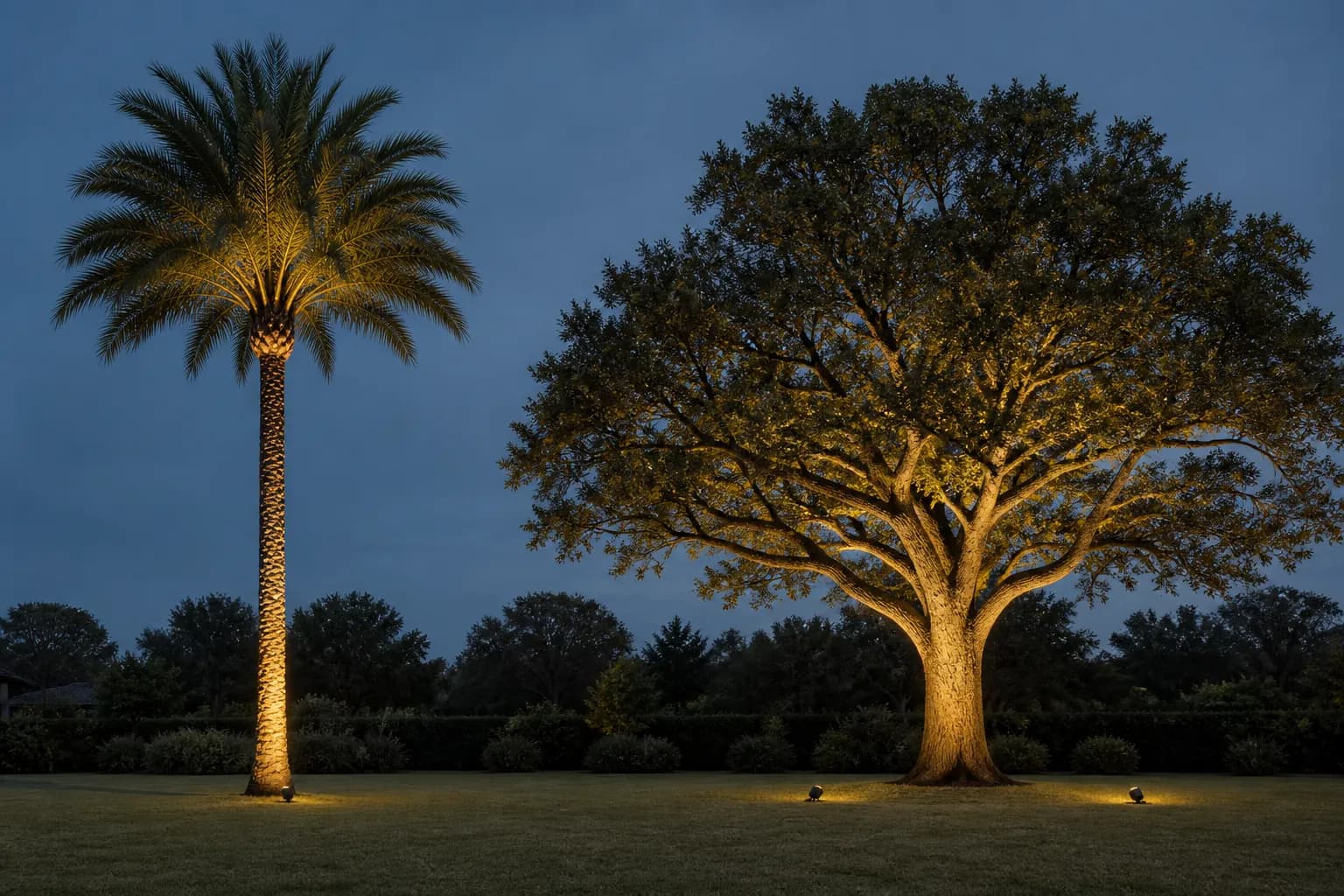
Palm / vertical form
Narrower beam often works well
Broad canopy
Layer trunk + canopy lighting
Ask whether you want the trunk, primary branches, canopy, texture, silhouette, or a combination. Sometimes the best result is not uniform coverage. Shadow creates depth. The goal is a beautiful tree from a distance, not every leaf.
You know what you want to light. Now choose where the fixture can live.
Placement: give the beam room
Put a fixture too close to the trunk and you can create a bright hotspot at the bottom while the upper tree disappears. Move it back and the beam gets room to open into the structure rather than crashing into the first few feet of bark.
For smaller and mid-size trees, a rough field starting point can sometimes be around one-third of the intended lit height as setback. Want useful light roughly 10 ft into a small tree? Starting around 3 ft back may put you in the neighborhood. This is not a formula. It stops scaling cleanly on tall trees and is overridden by beam angle, tree shape, obstacles, photometrics, and the desired effect. The real test happens at night.
The comparison should be readable before the paragraph: too close burns the base; stepping back lets the beam open.
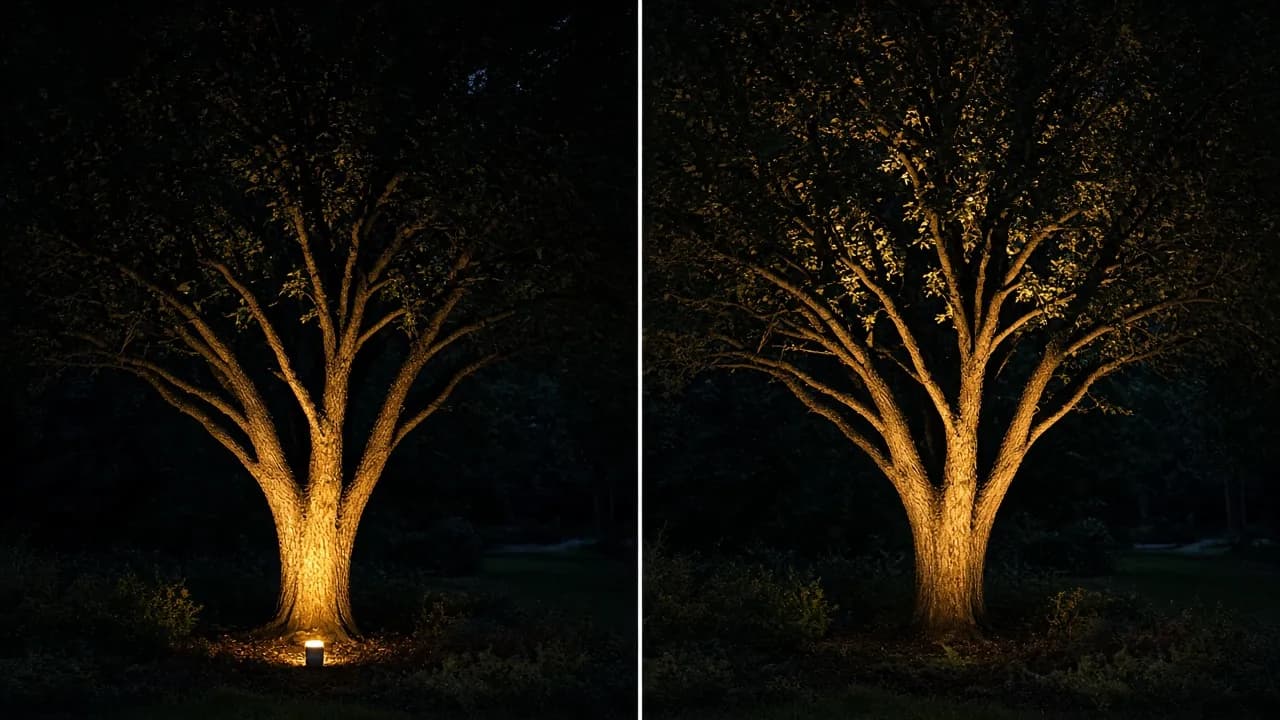
Too close
Hotspot at the base
Step back
Give the beam room to open
How many lights do I need?
There is no single fixture count. A young tree viewed from one side may look excellent with one fixture. A larger tree viewed from two seating areas may need two directions. A wide mature tree may need separate lighting for the trunk and canopy. A tree that is small today may need another fixture later.
Fixture count follows the sides people actually see: one view, two views, or walk-around.
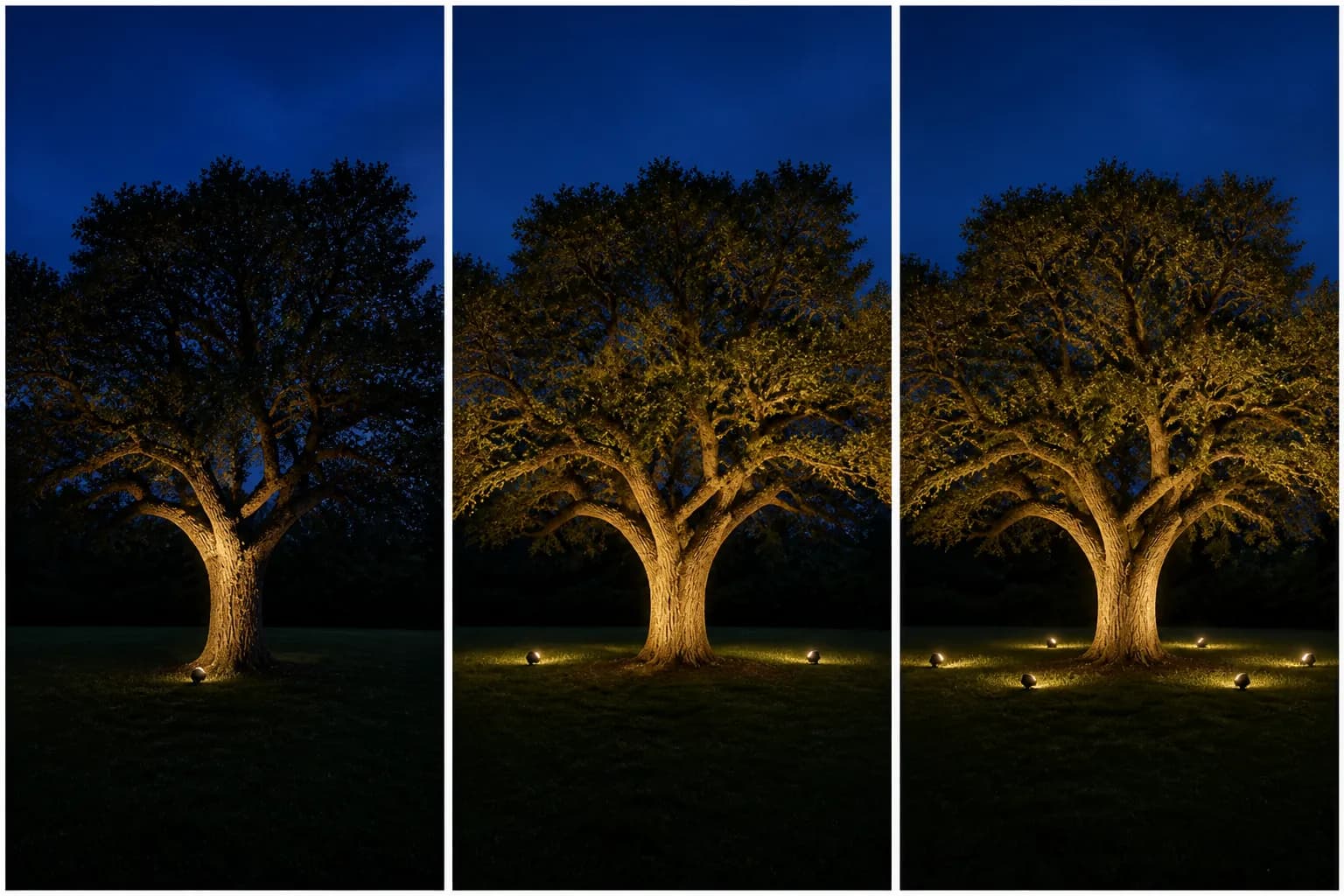
One-sided
Two-sided
Walk-around
- One fixture when the tree is small, there is one primary viewing side, and trunk and canopy can share a beam.
- Two or more when the tree is wide, there are multiple viewing sides, the canopy needs a different beam than the trunk, or growth will quickly outgrow a single light.
Do not add fixtures just because a chart says so. Add them because each light has a job.
Narrow, medium, wide — or a combination
The tree shape should drive the beam strategy. Narrower beams are often useful for palms, tall trunks, and long throw. Wider beams are often useful for broad canopies, spreading trees, and branch structures.
Strong tree lighting often uses more than one beam type: a narrow beam up the trunk, a wider beam into the canopy. That gives you control over two different parts of the same tree.
Use different beams when the trunk and canopy need different treatment.
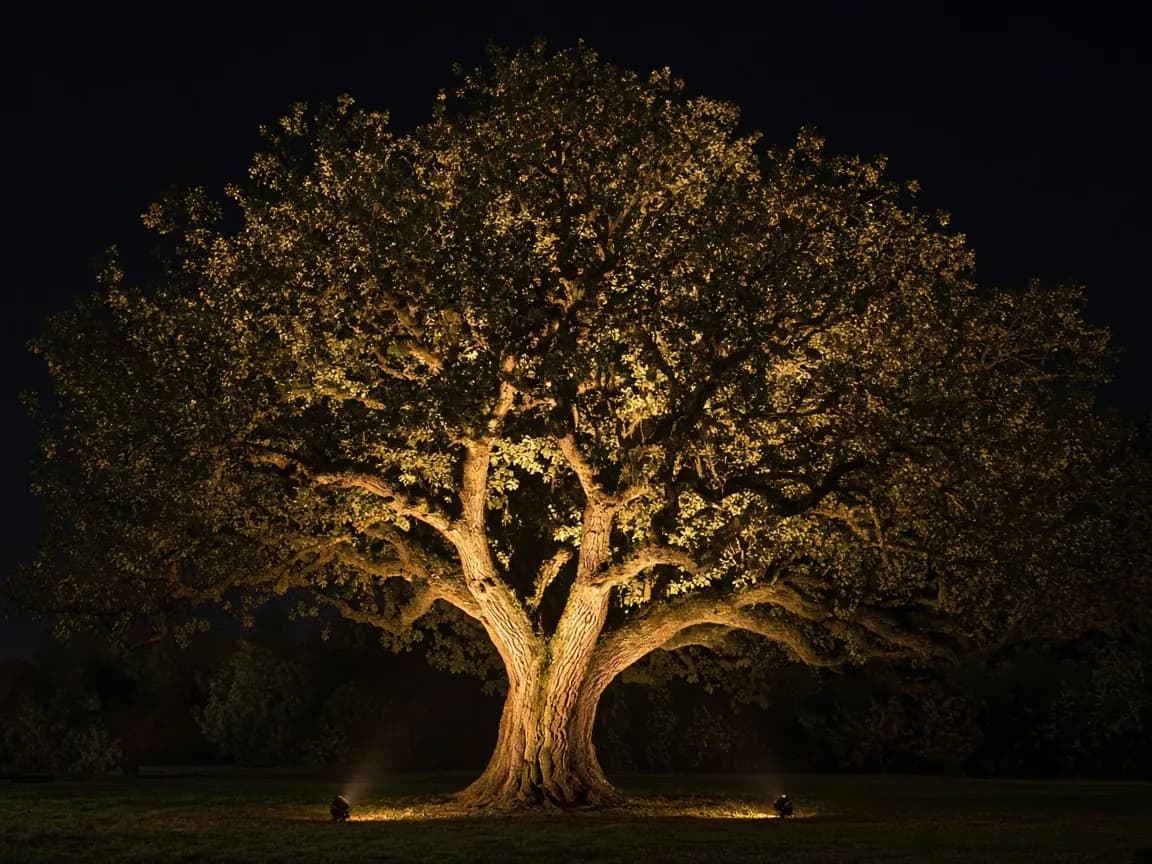
Narrower beam
Trunk / primary structure
Wider beam
Canopy coverage
Mixed strategy
One tree. More than one lighting job.
Beam geometry (advanced)
At 20 ft, using diameter ≈ 2 × distance × tan(beam angle / 2), a 15° beam is about 5.27 ft wide and a 60° beam is about 23.09 ft wide. That is a Projekt Supply geometric estimate, not manufacturer photometry.
| Distance | 15° | 25° | 35° | 60° |
|---|---|---|---|---|
| 5 ft | 1.32 ft | 2.22 ft | 3.15 ft | 5.77 ft |
| 10 ft | 2.63 ft | 4.43 ft | 6.31 ft | 11.55 ft |
| 20 ft | 5.27 ft | 8.87 ft | 12.61 ft | 23.09 ft |
| 30 ft | 7.90 ft | 13.30 ft | 18.92 ft | 34.64 ft |
The Projekt Supply 3–5–7 starting point
Projekt Supply 3–5–7 is a field shorthand for an initial residential LED aiming/output conversation. It is not photometry and it is not a universal specification. Watts measure electrical load. They do not tell you how far a beam will throw. Verify with the actual fixture photometry and nighttime aiming.
| Approximate target scale | Initial LED wattage conversation |
|---|---|
| Small shrubs / low material up to roughly 5–6 ft | around 3W |
| Roughly 5–7 ft | around 5W |
| Roughly 7–10 ft | around 7W |
| Above roughly 10 ft | begin evaluating 9W+, beam intensity, and/or multiple fixtures |
Once trees move into the 12–15 ft range and beyond, fixture count and directional intensity frequently matter more than simply stepping up wattage.
Well light, bullet, riser, or tree-mounted layer?
Fixture style is partly about the effect and partly about what is happening on the ground. An in-ground light is not automatically right under dense shrubs — if plants grow over the lens, the light has nowhere to go. Drainage and the exact product's installation requirements matter.
A properly designed adjustable tree ring can support fixtures without permanently fastening them into the trunk. Elevated or tree-mounted electrical work should use equipment intended for the application and be installed in accordance with manufacturer instructions and applicable electrical requirements. Do not improvise tree wiring.
Well, directional, riser, or a tree-mounted layer. Elevated electrical work should use equipment intended for the application.
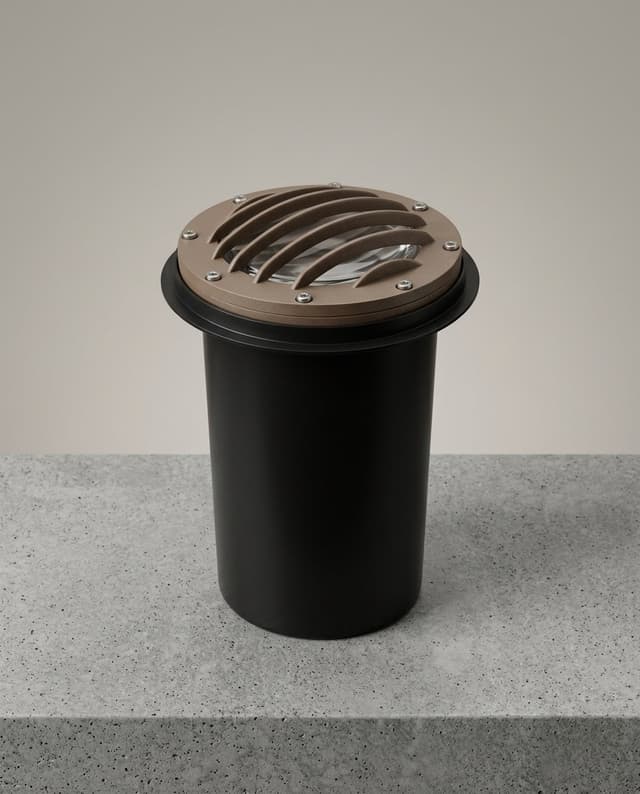
Well light
Hardware disappears
Hardware should disappear, and there is clear space above the aperture.
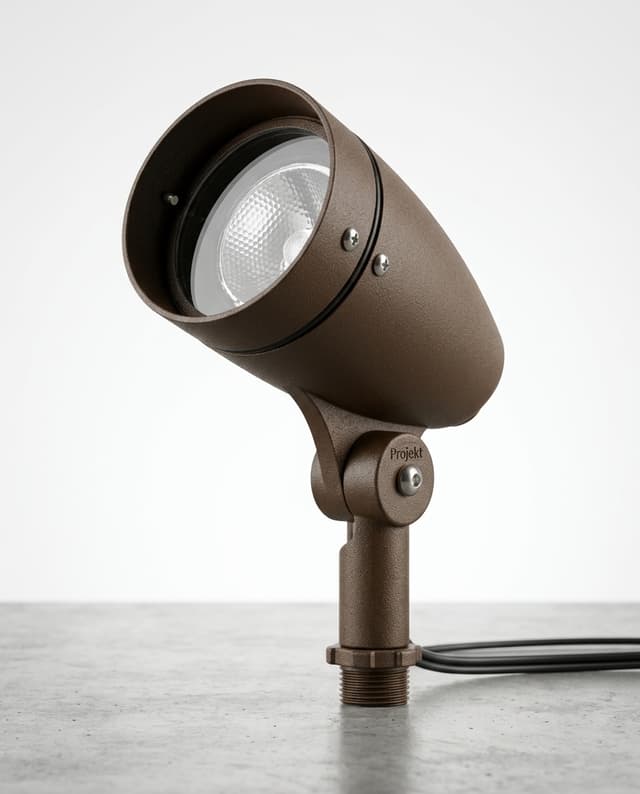
Directional uplight
Maximum aiming flexibility
Aiming flexibility matters, or shrubs would block an in-ground fixture.
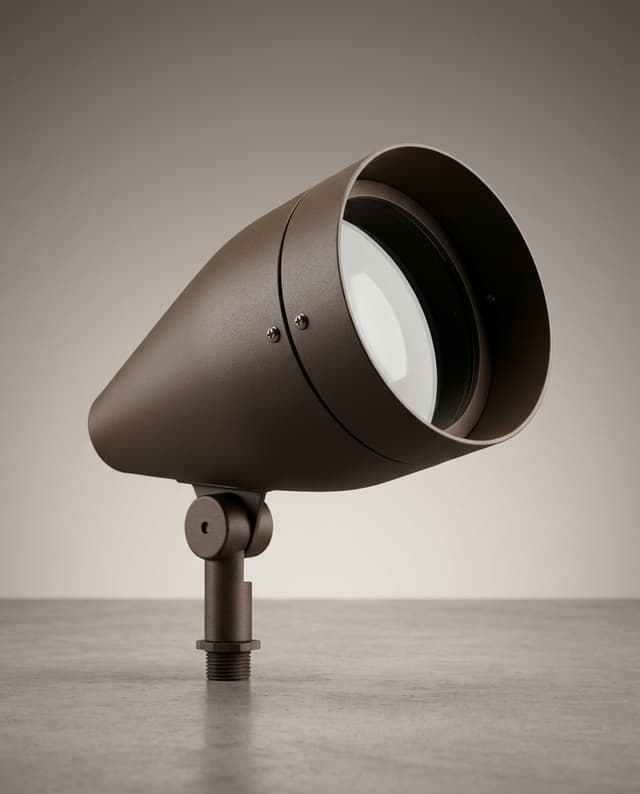
Riser-mounted light
Clears shrubs and groundcover
The beam must clear low shrubs, ground cover, or seasonal planting.
Tree-mounted layer
Adds canopy lighting or downlighting
The tree also supports canopy uplight or downlight onto a path or drive.
Conceptual mounting idea — not a catalog SKU.
Shop by tree-lighting job
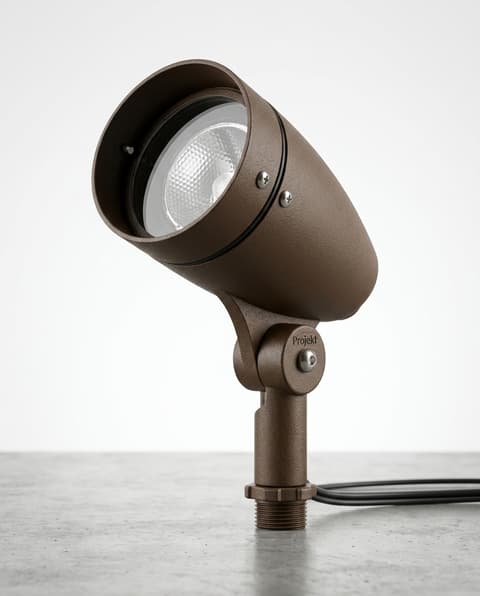
Directional uplights
Adjustable aiming for trunks, palms, and layered canopy shots.
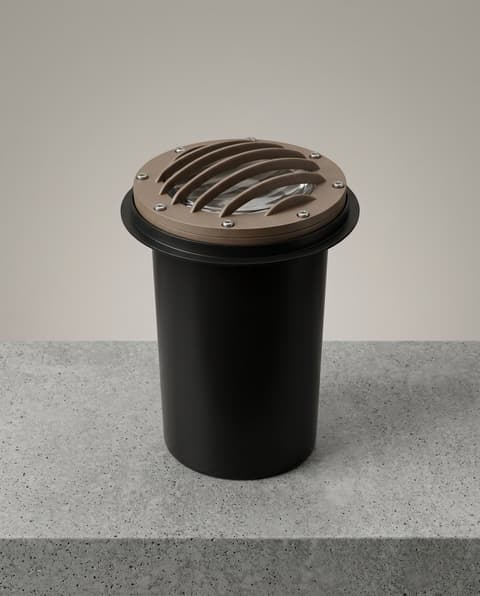
In-ground / well lights
When hardware should disappear in lawn, gravel, or paving.
Landscape transformers
The usual starting point for residential low-voltage tree lighting — size the system and leave room to grow.
Also compare Dabmar landscape spotlights and Dabmar in-ground lights.
You chose the fixture. Now choose the material.
Choose the material for the environment
Do not choose a fixture by brochure first. Choose it by where it has to live. Aluminum is a practical default for many inland residential jobs. Brass is worth considering for abuse or aggressive coastal air. Stainless grade matters near marine environments — do not assume all stainless performs the same. Composite or fiberglass can help in chemical-heavy landscapes, with a smaller fixture selection.
Warranty is backup, not the design strategy. No material is corrosion-proof.
Inland residential
Aluminum is often a practical starting point
Coastal / salt air
Consider brass, appropriate stainless, or corrosion-resistant composite
Chemical-heavy landscape
Consider composite / fiberglass
High-impact area
Favor heavier-duty construction
| Environment / condition | Start by considering |
|---|---|
| Typical inland residential landscape | Powder-coated aluminum |
| High physical abuse / frequent impact | Brass or other heavy-duty construction |
| Coastal / salt-air exposure | Brass, appropriately specified stainless, or corrosion-resistant composite |
| Chemical-heavy landscape / treated grounds | Corrosion-resistant composite/fiberglass or other specifically rated material |
| Design requires a very broad fixture choice | Aluminum often provides the largest range |
Warranty: useful, but not the first decision
A long warranty does not mean a fixture cannot fail. A "lifetime" warranty does not mean the physical fixture will last forever. Choose for the environment, then construction, then read the warranty.
You chose the fixture and material. Now choose the power system.
Low voltage or line voltage?
The first question is often simple: what is already there? If the property already has a working lighting system, tying into the existing voltage class may be the cleanest approach when capacity and compatibility allow.
For typical single-family residential landscape and tree lighting, low voltage is usually the starting point: flexible placement, easier expansion, and a practical LED landscape ecosystem. Line voltage is more common on commercial, multifamily, and public-access sites, or where higher-output architectural lighting is required.
Line-voltage work should be designed and installed by a qualified electrical professional.
Low voltage is more approachable, but it is not "no-code" or "no-risk." Use listed equipment, appropriate cable and connections, follow transformer and fixture instructions, and comply with local requirements.
Commercial & line-voltage tree lighting
These live catalog examples are line-voltage families. They are not the default residential 12V recommendation.
These public catalog records do not list beam angle in degrees, lumens, or candela, and they have no spec-sheet or IES file attached. Request manufacturer photometry / IES before ordering. Do not specify throw from wattage.
DPR21-L7-27K-BZ — DPR21
Directional spotlight · 120V line voltage · 27K
Beam angle not listed · lumens not listed · request photometry / IES before ordering
Listed load 7W — electrical load, not throw.
Line-voltage directional spotlight. Architecture example, not a 12V residential recommendation.
DPR38-L25S-27K-BZ-GL — DPR38-GL
Directional spotlight · spot-coded · 120V-277V line voltage · 27K
Beam angle not listed · lumens not listed · request photometry / IES before ordering
Listed load 25W — electrical load, not throw.
Line-voltage, spot-coded. L25S is an optic code, not a published degree. Request IES before ordering.
DW4701-L25S-27K-BZ — DW4701
In-ground well · spot-coded · 120V-277V line voltage · 27K
Beam angle not listed · lumens not listed · request photometry / IES before ordering
Listed load 25W — electrical load, not throw.
Line-voltage in-ground well. Hardware can disappear; photometry still has to be requested.
Wiring and transformers
Low-voltage LEDs can do a lot with a relatively small transformer, but load and distance still matter. Do not use a simple watts-per-feet shortcut as an electrical sizing formula.
Where the transformer manufacturer permits the intended loading, a useful Projekt Supply planning approach for an expandable tree-lighting zone is to avoid starting at the transformer's absolute maximum. Around 75% initial loading can leave useful headroom. This is a planning preference, not an electrical-code rule. Never exceed the actual transformer rating.
As distance and load increase, transformer and wiring strategy matter more. Around 75% initial loading can preserve headroom where the manufacturer rating allows — a planning target, not a code rule.
Need the math? Read the landscape voltage-drop guide
Need to size the transformer? How to size a landscape transformer
Controls: let the sun be your switch
Outdoor lighting needs to turn on at different clock times throughout the year because sunset changes. You can keep adjusting a mechanical timer. Or you can let the sun do the work.
Outdoor lighting schedules should adapt to the season without constant manual resets.
Photocell
Turns on at dusk
Photocell + timer
Dusk on, timed runtime
Smart control
Useful when integration matters
For many homes, photocell plus a run timer is the sweet spot: dusk on, then a chosen number of hours. Smart control is useful when it solves a real need. Verify outdoor rating, switching/load rating, transformer compatibility and inrush, connectivity, and what happens if the internet goes down. Do not replace an otherwise suitable transformer just to gain an app.
RGBW: one system, more choices
Traditional landscape lighting often asks you to choose a white color temperature and live with that choice. Compatible RGBW equipment can keep everyday white, then add event color, holiday scenes, or warmer/cooler whites without locking the property into one look forever.
It's your brush. It's your art. RGBW gives you a larger palette.
Aim for balance, not brightness
A perfectly lit tree is not necessarily the brightest tree. If one tree is dramatically brighter than everything around it, the eye keeps returning to that one point. Sometimes that is intentional. It should be a decision.
Judge the effect from the patio, the primary window, the driveway, the street, the pool, the seating area. Do not judge the final effect while standing directly over the fixture. Projekt Supply looks for no distracting hotspot, useful depth, visible structure, a canopy that does not disappear, no uncontrolled glare, and balance with the rest of the property.
Residential work usually starts warmer. Commercial work often starts somewhat cooler. That is not a rule. Check local project requirements, wildlife requirements, and DarkSky-oriented specifications where they apply.
Backlighting and lighting through the tree
A light does not always need to hit the front face of the trunk. Sometimes the better move is to light through the tree. A fixture placed behind or beside the primary viewing angle can create depth and show branch structure without putting the brightest part of the beam in front of the viewer.
Sometimes the best way to light the front of a tree is not from the front.
Walk the line every six months
A lighting system can be designed correctly and then slowly fall apart visually. The fixture did not necessarily fail. The landscape changed around it.
A quick twice-yearly check helps preserve the original lighting effect.
Keep the original design alive
1
Pick up
2
Clean
3
Clear growth
4
Re-aim
5
Check connection
6
Re-balance
Pick up / reset the fixture. Clean the lens. Clear new growth. Re-aim. Check the connection. Re-balance the scene
Sometimes the fix is literally: pick the light up, turn it back on, and see what happens. Protect the investment by maintaining the effect.
Troubleshooting tree lighting
Appearance problems are aiming, placement, beam, and growth. Outages follow the wire upstream.
Light is on, but looks wrong
- → Aim
- → Placement
- → Beam
- → Growth / obstruction
- → Add another direction if needed
Light is out
One fixture?→ Fixture / lamp / local connection
Several fixtures?→ Follow the wire upstream
Whole system?→ Transformer / power / control
The light works, but it looks wrong
- Bright hotspot at the bottom: re-aim, move farther back if possible, check whether the beam is opening in the wrong place, or layer another direction rather than adding output.
- Top of the tree is dark: is the fixture aimed at the canopy or only the trunk? Is a branch blocking the beam? Would a second lighting direction solve it better than more wattage? Has growth changed the original path?
- Tree looks flat: try a second direction, a different beam, backlighting, or separating trunk and canopy into different jobs.
- Glare from a window or seating area: re-aim away from the viewer, move the source, add shielding where compatible, or change the lighting direction so the viewer sees the tree rather than the lamp.
The light is out
One fixture: start at that fixture. Several fixtures in the same section: look upstream — it is less likely that four fixtures all failed at once. Everything out: transformer, breaker/GFCI, photocell seeing artificial light, timer, or a smart control offline. If electrical testing goes beyond basic visual checks, bring in a qualified professional.
Quick field checklist: standing in front of the tree
The tree
- How tall is it now?
- How wide is it?
- How fast will it grow?
- Palm/vertical, branching, wide canopy, multi-trunk, seasonal foliage?
- What part of the tree is actually beautiful?
The view
- Where will people see it from?
- One view, two views, or walk-around?
- Is it meant to be a focal point or part of a larger composition?
The ground
- Open soil, lawn, planter, gravel, paving?
- Ground cover or shrubs?
- Irrigation, mowers, gardeners, foot or vehicle traffic?
- Can a fixture physically live there?
The fixture
- Well light, bullet, riser, or elevated/tree-mounted layer?
- Narrow, medium, wide, or mixed beam?
- Enough aiming range, and easy to re-aim later?
The environment
- Inland, coastal, high humidity, chemical exposure, or high physical abuse?
- Aluminum, brass, stainless, or composite?
The power
- Existing low voltage or line voltage?
- Transformer capacity, cable length, voltage drop, future expansion?
The control
- Photocell, photocell + run timer, switch, smart integration, RGBW?
The night test
- Hotspot? Dark canopy? Glare? Flat? Balanced with the rest of the property?
Common tree uplighting questions
- How far from a tree should an uplight be?
- There is no universal distance. The fixture needs enough room for the beam to open into the part of the tree you want to light. For small and mid-size work, roughly one-third of the intended lit height can be a useful first field test, but beam angle, tree form, obstacles, and photometrics override the shortcut. Aim and adjust at night.
- How many uplights does a tree need?
- Start with the viewing angles and tree form. A small tree with one primary view may need one fixture. A wide tree, multiple viewing sides, or separate trunk and canopy lighting can require two or more. Each fixture should have a reason to be there.
- Should I use a well light or a spotlight for a tree?
- Use a well light when you need the hardware to disappear and there is clear space above the aperture. Use an adjustable bullet/spotlight when aiming flexibility matters or when shrubs and ground cover would block an in-ground fixture. Traffic, maintenance, drainage, and future re-aiming all matter.
- What color temperature is best for tree lighting?
- There is no single correct color. Projekt Supply normally starts warmer for residential landscapes and often somewhat cooler for commercial work, then adjusts for architecture, plant material, ambient light, local requirements, and personal preference. RGBW systems can add even more flexibility.
- Should tree lighting be low voltage or line voltage?
- Most typical single-family residential landscape lighting starts with low voltage. Line voltage is more common in commercial, multifamily, public-access, or higher-output applications. Existing infrastructure, fixture requirements, run length, output, and local electrical requirements should drive the decision.
- How often should landscape uplights be adjusted?
- A six-month check is a good practical rhythm. Clean lenses, clear new growth, stand fixtures back up, check stakes and connections, re-aim beams, and make sure the overall property is still balanced.
- Why are several landscape lights out at once?
- If one fixture is out, start at that fixture. If several fixtures in the same section fail together, look upstream for a cut/disconnected cable, branch connection, transformer connection, or control-zone problem. If the whole system is out, check the transformer, power source, protective devices, photocell, timer, or smart control.
The system should grow with you
There is no single correct way to light every tree. There are better choices for the environment, better places to start, and mistakes that can be avoided. What one person loves, another person may not. Projekt Supply's job is not to tell you that your tree must look one particular way.
Lighting that grows with you.
It's your brush. It's your art. We provide the tools.
Return to the lighting guides. Need a shielded path light instead of a tree uplight? Read how to pick a bollard. Related families: DPR21, DW4701, landscape spotlights, in-ground lights.
These values are design starting points, not universal fixture prescriptions. Final performance depends on exact tree geometry, photometrics, ambient light, fixture output, aiming, and field adjustment.
Third-party trademarks and trade names are the property of their respective owners. References, when included, are provided for technical source attribution and identification only and do not imply affiliation, sponsorship, or endorsement.
Technical references
- U.S. Department of Energy — Lumens and the Lighting Facts LabelIndependent technical sourceIndependent explanation that lumens measure light output and watts measure energy use.
- NIST — SI Units: CandelaIndependent technical sourceCandela is the SI unit of luminous intensity — light in a given direction.
- DarkSky International — DarkSky Approved Luminaires guidelines v3.1Independent technical sourceProduct-certification criteria and responsible-lighting principles. Not a claim that every project must follow DarkSky product rules.
- Projekt Supply — Geometric beam-diameter approximationProjekt Supply calculationdiameter ≈ 2 × distance × tan(beam angle / 2). Teaching estimate only; use manufacturer IES/photometry for fixture selection.